Who Will be the Winner on the Korean Peninsula?
- Jun 19
- 3 min read
Updated: Jun 20
In every matter of the world, meaningful differences inevitably arise from the insight into history and the preparation for the future.
As Prime Minister Winston Churchill stated, “ A nation that forgets its past has no future.” Many leaders around the world have expressed the same.
The Korean Peninsula, in particular, carries important implications for the future of the world.
Many know little about the history of Japan’s colonial rule over the Korean Peninsula in the twentieth century. For thirty five years, Japan extracted resources from the Peninsula, including rice, timber, coal, and iron ore, controlled its people, and sought to erase its history, culture, and language. After the end of World War II, Korea endured brutal poverty. Then, after liberation, it experienced another devastating civil war, which destroyed nearly everything and made the Peninsula one of the poorest regions in the world. Yet, half a century later, South Korea has become an essential partner in economic development for many countries and regions, including the United States.
Koreans possess one of the rarest forms of DNA in the world, one centered on community, industrialization, and democratization. This DNA also exists in North Korea, whose people share the same ethnic roots with South Koreans. That is among the reasons as to why companies from other parts of the world should invest in the Korean Peninsula. The history of economic prosperity will almost certainly repeat itself there.
In reality, major powers including the United States, Japan, and European countries imagine entering the Korean Peninsula after North Korea opens and earning enormous profits through investments in minerals, rare earth elements, and real estate. However, that approach ignores the most important value of the Korean Peninsula : its community-centered DNA. It resembles the nineteenth-century practice of foreign countries looting the Peninsula’s brilliant cultural artifacts, many of which were among the first or finest of their kind in the world, and collecting them as trophies in their own museums. The artifacts taken by other countries still belong to the Korean Peninsula. However, the imperial and extractive approaches western powers used in the past will no longer work in South Korea or North Korea, whose national strength and awareness have become too significant to ignore.
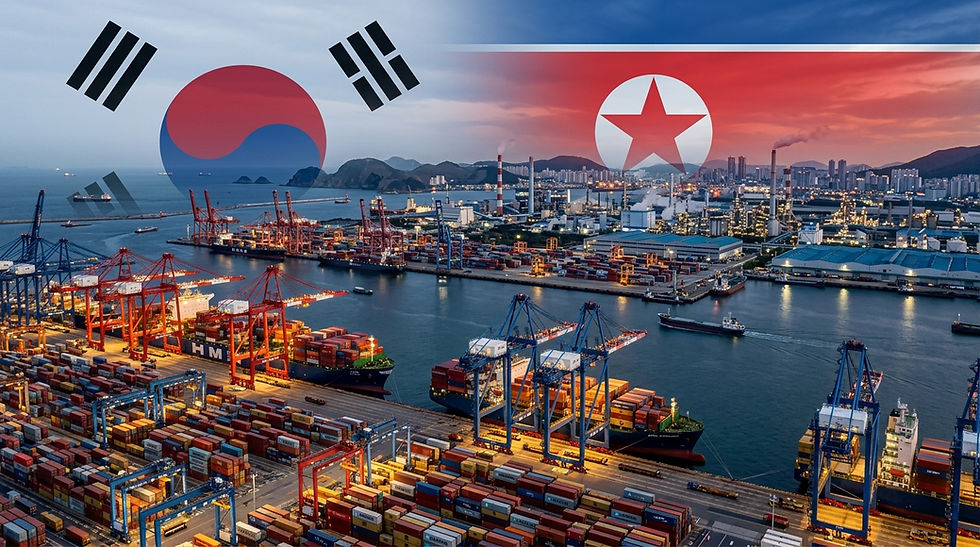
The industries that win on the Korean Peninsula may be those that improve the lives of North Korean communities and build their infrastructure. These include fields that major powers such as the United States, China, and Japan may not fully imagine, including education, food, telecommunications, and energy. The Korean Peninsula will likely seek to become a new global economic center that provides new forms of growth opportunities not only for East Asia, but also for the world economy. Such opportunities will be given first not to those that exploit their resources and labor, but to those that understand the history of and appreciate people of the Korean Peninsula and seek to grow with them. That is because North Korea’s military regime, like South Korea, also shares the DNA of the Korean Peninsula formed over thousands of years.
We respect the Korean Peninsula and seek to support its values and existence. More importantly, we seek to engage with its people in a new way, one fundamentally different from the approaches of the past. We possess their historical and cultural knowledge, political and economic experience, and a network of best specialists on the Peninsula that possess the DNA formed on the Korean Peninsula. It is the Peninsula’s new development we seek to contribute to. In that process, we will create and provide opportunities through which allies such as the United States and Japan can also make their part of contribution.