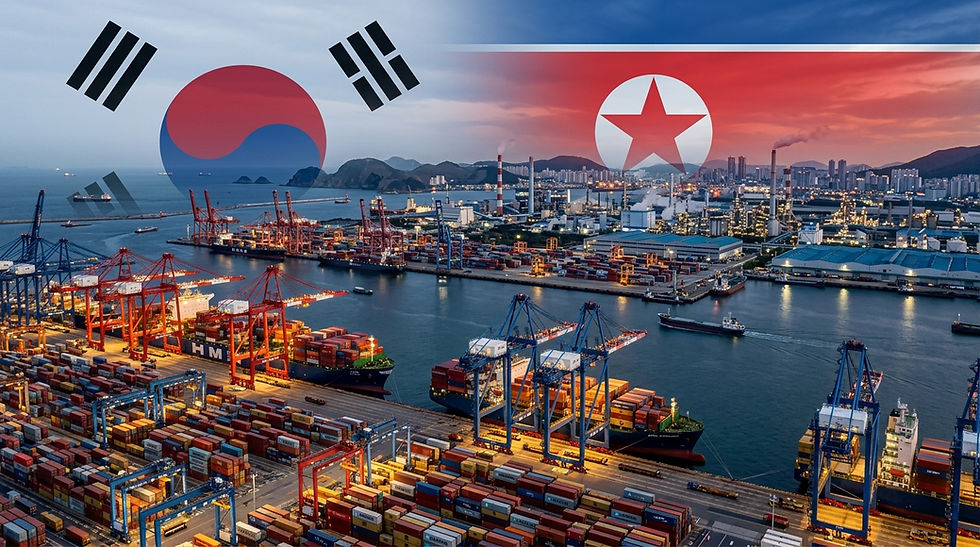
Competition for Transportation Sector Dominance in North Korea
Updated: Jun 6

Following North Korea's opening to the United States, one of the first markets likely to expand rapidly will be the transportation sector. North Korea has a population of approximately 25 million people with a substantial share of younger consumers. Given the nation’s limited transportation infrastructure and low level of personal vehicle ownership, the demand for motorcycles, compact vehicles, and low power electric transportation platforms could increase quickly during the early stages of North Korea's economic opening.
Yet, who will dominate this market first is the question. Over the past decade, China has aggressively expanded low cost motorcycle and compact transportation supply chains across Southeast Asia and developing economies. Following the opening of North Korea, Chinese manufacturers could move into the market rapidly at scale. However, this is not merely a question of motorcycle sales. Whoever that dominates the transportation market first could expand its influence across parts supply, maintenance, logistics, distribution, financing, and the broader manufacturing ecosystem. South Korean companies will likely take a preemptive action to secure the exclusivity for negotiating with North Korea for the dominance.
Furthermore, North Korea’s energy and fuel infrastructure may limit approaches centered entirely on internal combustion vehicles. Fuel based transportation may remain concentrated on the trucking and commercial logistics where productivity and transport efficiency are critical, while low power electric and motor based transportation platforms could spread more rapidly across personal transportation markets. This may create opportunities for South Korean companies to establish new low cost transportation platforms and manufacturing standards extending beyond North Korea into broader Asian markets.
South Korean companies are likely to utilize used vehicle distribution networks involving South Korea and Japan, Southeast Asian inventory markets, motorcycle and compact vehicle wholesale networks, and certification systems. South Korean companies will also likely produce and standardize low power electric transportation platforms domestically for their future expansion in North Korea and Southeast Asia. This strategy can give South Korean companies an advantage over the Chinese companies in shaping a new northern consumer, logistics, and manufacturing ecosystem.